An Aum School Project
Dharma Bee is a project of Aum School, a Sanatan Dharmic-principles based school in the United States.
You are viewing: Aum Little Learners — Lathrop, CA

An exciting competitive program that deepens understanding of dharmic knowledge through quiz-based learning.
A Knowledge Competition Celebrating Sanatan Heritage
Dharma Bee is a project of Aum School, a Sanatan Dharmic-principles based school in the United States.
Dharma Bee is a competition similar to spelling bee, math bee, etc.
Prizes will be awarded to contestants who demonstrate the most knowledge of Sanatan scriptures, epics, folklore and cultural stories via a combination of online and in-person competitions.
The subject of the competition is Ramayana. We are using Bibek Debroy's book, Valmiki Ramayana, as our guide.
It is open to students from grades 1 to 8 in the United States of America.
In the years to come, the scope of the contest will expand to cover various dharmic topics for all age groups.
Learn about the competition process and what to expect.
Not monitored. This round is open to all who register. This is a non-qualifying round.
Timeframe of two weeks given to complete an activity such as coloring, shloka recitation, costume design & display, etc.
In-person in a partner location or virtual, monitored in cities where we are able to partner with an in-person coordinator. This is a qualifying round.
In-person. Quiz, and essay writing within a predefined time. Venue for 2027 is Houston, Texas.
The competition level is organized based on grade level clusters.
Question topics may overlap; however, the difficulty level will be adjusted according to the grade clusters.
| Level | Grades |
|---|---|
| Level 1 | Grades 1–2 |
| Level 2 | Grades 3–4 |
| Level 3 | Grades 5–6 |
| Level 4 | Grades 7–8 |
The competition rounds will be organized by volunteer coordinators in each state where the competition will run. The coordinators will be the first level contacts for all parents, guardians, and contestants in their state.
The competition will not run in Arizona, Connecticut, Maryland, North Dakota, Nebraska, and Tennessee due to state laws.
The key points from the 2027 Official Rules. Please read the full rules before registering.
US residents in grades 1–8 (public, private, parochial or home-study). A parent or guardian registers the child. Not open in Arizona, Connecticut, Maryland, North Dakota, Nebraska or Tennessee.
Registration is open from Tuesday, October 20 to Sunday, November 22, 2026.
$30 per child, non-refundable.
Round 1 virtual quiz (about 99% advance) · Round 2 activity (score 50+ advances) · Round 3 regional quiz (top 30 per level advance) · Round 4 in-person final.
1st $1,000 · 2nd $750 · 3rd $500. Finalists also receive a medal, a certificate and a book.
A panel of qualified judges scores every entry against set criteria. Ties are broken with extra oral or written questions or an essay.
Nurturing values, knowledge, and a love for Dharma.
The significance of this endeavor is its ability to reconnect the younger generation with their cultural heritage.
It will help foster a deeper understanding and reverence for Sanatan Dharmic values.
The invaluable knowledge our youth gain will empower them to lead lives filled with integrity, compassion, and wisdom, rooted in the principles of Sanatan Dharma.
We see this effort instilling a sense of pride in our heritage among individuals of all ages.
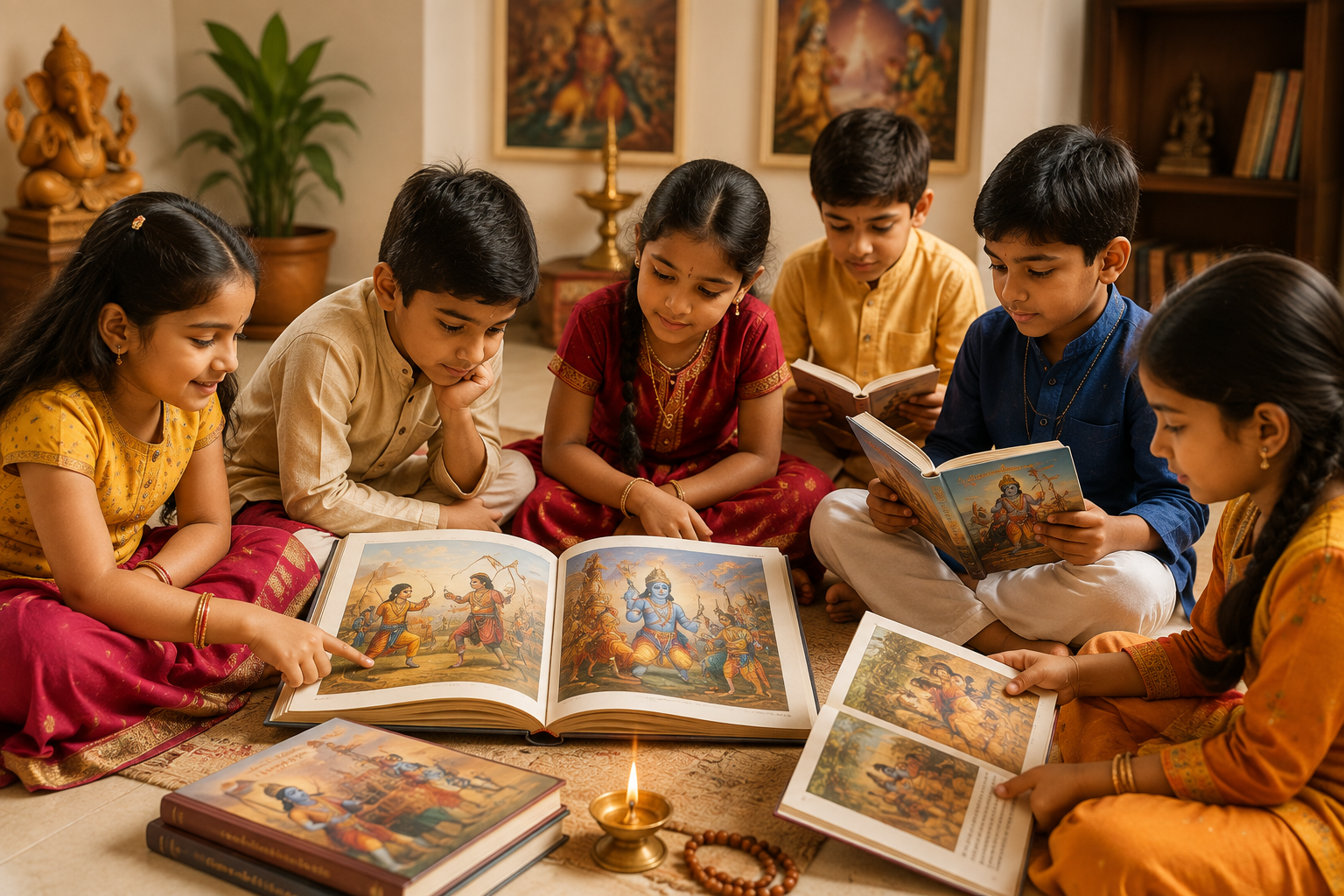

Our mission is to champion the rich cultural heritage of Sanatana Dharma through dynamic competitions. By infusing the elements of excitement and challenge into the Dharma Bee competitions:
A Lasting Message from Dr. Bibek Debroy on Dharma Bee, Ramayana, and Preserving Our Heritage.

Scholar • Economist • Author • Sanskrit Translator
I am delighted that Aum School has revived the Dharma Bee initiative. I am particularly happy that this year's focus is Ramayana. Most Indians have a passing degree of familiarity with Itihasa (Ramayana, Mahabharata) and Puranas. But often, especially among the young, the familiarity is not deep enough, perhaps even more so if the individual happens to be in North America. Often, that familiarity is distorted, based on wrong notions, distorted by the interpretations of a Western lens. It is important that the young be exposed to the true nature of our history and heritage, of which, Ramayana is an integral part. There are non-Sanskrit versions of Ramayana too, such as Tulsidas. Within Sanskrit, one should mention Valmiki Ramayana, Adhyatma Ramayana, Yogavasishtha Ramayana, Raghuvamsham by Kalidasa and the Rama story in the Mahabharata. Valmiki was the first poet (kavi) and Valmiki Ramayana is the most important among the ones I have mentioned. The poetry is beautiful. Ramayana means Rama's journey, or Rama's progress. Though that was treta yuga and we are now in kali yuga, through the Dharma Bee initiative, the young will come to appreciate Rama's journey and conduct much better. I wish the initiative and the participants all success.
Former Chairman, Economic Advisory Council to the Prime Minister.
Author and scholar whose work spanned economics, history, culture, and philosophy.
Known for translating major Sanskrit works, including the Mahabharata and Valmiki Ramayana.
Helped make India's ancient knowledge and heritage more accessible to contemporary audiences.
His words continue to inspire young minds to discover, understand, and cherish our heritage.